

Give
Creating Vanguard Verses
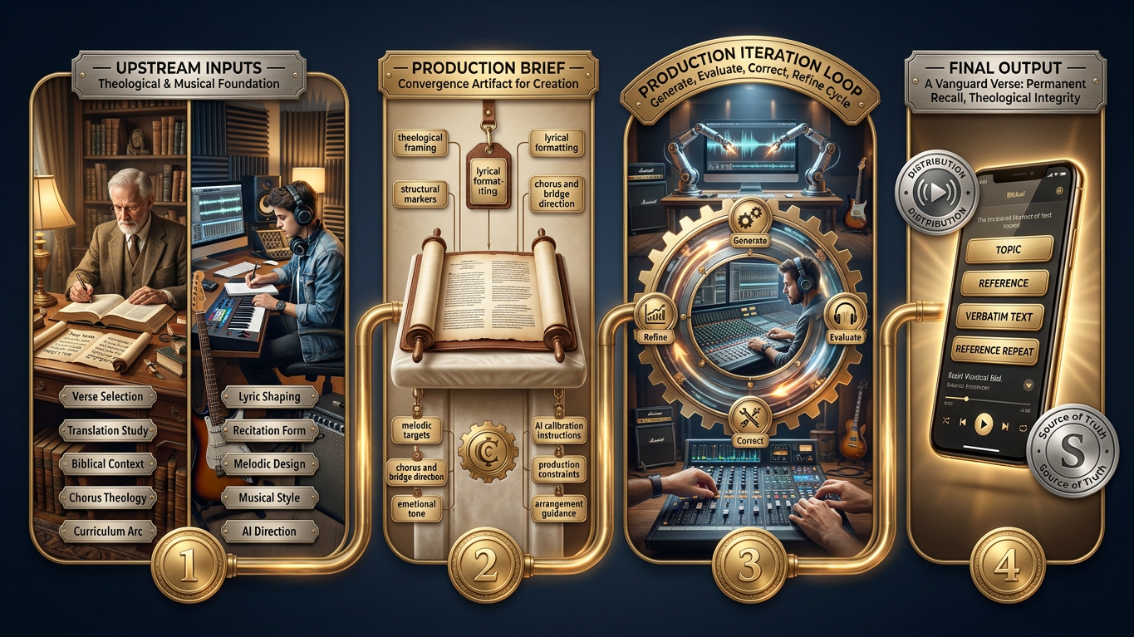
Vanguard Verse — Anatomy of a Song
Click any element to read its full description.
Click any element in the diagram to read its full description.
Verse selection
It starts with a question most scripture memory systems never ask: not "what verses should people memorize?" but "what does a believer need to have loaded when the enemy advances?" That is a different question. It produces a different list.
Formation sequence. A verse that is powerful in isolation may not belong in the first twelve weeks. The curriculum is designed so that early verses build a foundation that later verses assume. Sequence is theology.
Retrieval pressure. The question driving selection is: when will this verse be needed, and in what condition will the person be when they reach for it? Verses selected for comfort function differently than verses selected for temptation resistance, which function differently than verses selected for witness.
Singability potential. Some verses that are theologically essential are syntactically difficult to set to music without distorting the text. The selection process has to hold both.
Misuse risk. Some of the most powerful verses in scripture are also the most frequently taken out of context. A verse with high misuse history requires more chorus and bridge work to fence it properly.
The 240-verse arc. Every verse selected is a commitment. The selection has to hold up not just as individual choices but as a coherent curriculum — doctrinally comprehensive, spiritually sequenced, and collectively sufficient to arm a believer for the full range of battles they will face across a lifetime.
Translation study
It serves two masters simultaneously. Most Bible study pursues one thing from translation comparison: the most accurate rendering of the original. Translation study in Vanguard Verse pursues that — and then asks a second question the original scholars never had to answer: can this be sung without losing a word?
The load-bearing word. Every verse has one — the word on which the theological weight rests. The musical setting has to land on that word with melodic emphasis, not bury it in an unstressed syllable.
What the verse doesn't say. Translation comparison reveals where translators have made interpretive choices that open the door to misreading. Understanding those choices informs what the chorus and bridge need to close.
The spoken rhythm of the text. The study includes reading the text aloud across versions — listening to where the natural stress falls and whether it aligns with what the verse is actually saying.
The Spanish parallel. For any verse that will be set in Spanish, the translation study runs twice. The singable wording in each language has to be theologically equivalent, not just translated.
Biblical context
It is the answer to a question that sounds simple and isn't: what is this verse actually doing? Not what does it say. What is it doing. Those are different questions and they produce different songs.
The passage before and after. The passage before the verse tells you what problem the verse is solving. The passage after tells you where the verse is going. Together they reveal what the verse is not permitted to mean.
The author, the audience, the situation. Who wrote this verse, to whom, and why they needed to hear it shapes the emotional register of the song. A verse written by Paul from prison carries a different weight than the same theological content written in a moment of triumph.
The book's argument. Individual verses exist inside books that have arguments. Understanding where a verse sits inside that movement reveals what work the verse is doing in the larger structure.
The canonical frame. Every verse exists inside the whole of scripture — and the whole of scripture interprets its parts. Biblical context study always asks: how does the rest of scripture speak to this verse, and does that canonical conversation change what the song should say?
Chorus theology
It is the part of the process that has no parallel anywhere else in scripture music. Most worship songs treat the chorus as the emotional peak. That is not what the chorus and bridge do in a Vanguard Verse song. Here they serve a specific theological function: they complete the interpretive frame so that the verse cannot be lifted out and used incorrectly. The chorus and bridge are the fence.
The chorus anchors the correct application. A believer who has sung the chorus two hundred times has sung the correct interpretation two hundred times. The misreading doesn't get a foothold because the right reading is already installed alongside the text.
The bridge addresses the tension the verse creates. Most significant scripture verses create a real question in the honest listener. The bridge is where that tension gets acknowledged and resolved scripturally, not avoided.
The ending locks the reference. The musical ending reinforces the theological context one final time, so the last thing the listener carries out is not just the text but the meaning the text was meant to carry.
A Vanguard Verse song cannot easily be used incorrectly. Text and interpretation are encoded together — inseparably — through the same melodic memory mechanism.
Curriculum arc
The arc is not a system. But it isn't random either. It is 240 verses chosen by someone who has lived in the Word long enough to know which ones show up when it counts — not which ones are theologically important in the abstract, but which ones a believer actually reaches for in the moment the battle is real.
Most believers won't enter the curriculum at verse one and march through to verse 240. They'll find Vanguard Verse because a specific verse reached them at a specific moment — in grief, in temptation, through a friend. The arc matters not because it dictates a path but because it guarantees that wherever someone enters, there is something there for them.
Phase 0 — the first 24 verses, already written and field-tested inside Grace Discipleship Community. The foundational verses a believer needs before anything else.
Phase 1 (FOUNDATIONS) — the first 60 verses. A believer who carries all 60 has the Word loaded for the most common and most dangerous battles.
Phases 2 and 3 — the complete 240. The definitive adult scripture memory resource, covering every domain of life a believer will face.
The 240 is not a textbook. It is a library built by someone who knows what people need when they're losing.
Lyric shaping
It is the negotiation between two things that don't naturally want to cooperate: the exact words of scripture, and the demands of a melody that will carry those words into permanent memory. The text is fixed. The music has to be built to carry it.
Word stress mapping. Every word in a verse has a natural spoken stress pattern. Every melodic phrase has stress points built into its rhythm. When those two systems align, the lyric installs naturally. When they conflict, the listener either mishears the emphasis or the melody sounds forced.
The compression problem. The earworm research is clear — shorter melodic units with repetition outperform longer continuous phrases for involuntary recall. Lyric shaping means finding the natural breaks inside a long verse and building the musical structure around those breaks.
The unsacrificed word. Every word in the verse text is non-negotiable. Not one word gets softened, dropped, reordered, or replaced with a synonym that scans better. The music serves the text. Not the other way around.
When lyric shaping is done correctly, an 18-month-old who barely speaks English can say Psalm 34:7 word for word after four days of listening.
Recitation form
It is the structural skeleton that turns a pleasant scripture song into a precision memory instrument. The weapon requires the address — retrievable in both directions, verse to reference and reference to verse, under pressure, without the music playing.
Topic. The verse is introduced by its subject before a single word of text is sung. This is the contextual anchor that makes the text land in the right category of memory.
Address. The reference is sung before the text. The mind hears the address and then immediately hears what the address points to. That pairing encodes with every listening.
Verse. The exact text of scripture. Every word. No paraphrase, no softening, no compression.
Address again. The reference repeats at the end. After hearing the verse text, the mind hears the reference again and the association is reinforced from the opposite direction. Now the text can retrieve the address, and the address can retrieve the text. The weapon works in both directions.
Melodic design
It starts with a body of research that secular music scientists produced with no theological interest whatsoever — which is precisely what makes it useful. The study of Involuntary Musical Imagery has identified the specific features that predict which songs replay in the mind without deliberate effort. Those features are designable.
Melodic contour. The shape of a melody is the single strongest predictor of involuntary replay. The target is a contour that feels both familiar and worth revisiting — simple enough to follow on first hearing, with one interval that makes the mind want to return.
Tempo. Songs with moderate to slightly-above-moderate tempo encode in procedural memory — the same system that encodes physical skills like riding a bike. Procedural memory doesn't decay. It surfaces on its own.
Repetition structure. Internal repetition within a song dramatically increases both frequency and duration of involuntary replay. The melody is built around the verse text's natural repetition points.
The dual-task constraint. When melody and text are in tension, working memory consumed by resolving the conflict cannot encode the text. Vanguard Verse melodies deliberately choose lyric clarity over musical sophistication. The goal is not interesting music. The goal is the Word in the memory, permanently.
Musical style
It begins with a premise most music ministries haven't fully reckoned with: the verse doesn't care what style carries it. The listener does. The theological content of Titus 2:11-12 is identical whether it arrives as post-grunge or folk. What is not identical is which listener will put it on repeat on the drive home.
The listener-first question. Style selection starts not with "what would sound good for this verse?" but "who needs to carry this verse, and what are they already listening to?"
The style-as-delivery-vehicle principle. The enemy has owned the airwaves for generations by understanding this completely. The Word travels in whatever style already has access to the listener who needs it. The style is the vehicle, not the message.
The Titus 2:11-12 precedent. Two completely different musical styles — post-grunge and folk — same text, same theological architecture, same memory outcome. But the post-grunge version reaches a listener the folk version will never reach.
The style has to be genuine. A verse set in the wrong style gets heard once. A verse set in the right style gets heard until the Word is permanent.
AI direction
Human creative direction is not one element among eleven. It is the force that operates inside every other element on this diagram. The tool produces sound. The human determines whether that sound becomes scripture formation.
Suno can generate a melody. It cannot decide whether that melody will carry a verse into permanent memory, or just make it pleasant to hear once. It cannot hear when a chorus subtly shifts the verse's meaning. It cannot tell when a bridge resolves tension in a way that would allow the song to be misappropriated.
What goes into Suno is not a verse — it is a precise brief. What comes out is evaluated not for whether it sounds good, but for whether it will install the Word accurately and permanently.
You cannot buy the tool and replicate the output. The tool is available to anyone. What is not available is the decision architecture that tells the tool what to do and knows the difference between a song that sounds like scripture and a song that installs scripture permanently.
The AI is the printing press. The theological and musical work that precedes it is the manuscript.
Production brief
By the time the production brief is assembled, every theological and musical decision has been made. The verse is selected. The text has been studied across translations. The context is understood. The singable wording is set. The recitation form is locked. The melodic target is defined. The style is chosen. The chorus theology is drafted.
The brief is not a simple prompt. It is a multi-layered set of instructions built from hard-won technical knowledge of how Suno interprets what it receives. It includes a precise style description, structural markers embedded in the lyric, specific exclusions, and calibration of how tightly or loosely the production should interpret the brief.
Getting the brief right is itself an iterative skill. A brief that is too tight produces something technically correct with no life in it. A brief that is too loose produces something energetic that doesn't serve the text. Finding the balance requires having been wrong in both directions enough times to know where the edges are.
This is where all ten upstream elements converge into a single set of instructions — and where the production process begins.
Production iteration
This is where everything upstream meets resistance — and where the difference between a song that installs the Word and a song that merely contains it gets decided. The brief enters Suno. The tool returns a version. And the work begins.
What the sliders govern. Suno's production parameters shape the relationship between the lyric and the musical arrangement — how much the vocal sits in front, how the instrumental elements are weighted. These are adjusted round by round based on what each version reveals.
The pronunciation problem. An AI voice doesn't read — it pattern-matches. Homographs — words with a single spelling and multiple possible pronunciations — must be managed through phonetic engineering inside the lyric itself. Spelling modifications guide the AI voice toward the correct pronunciation. This skill is learned by getting it wrong and correcting it.
What iteration actually looks like. Psalm 34:7 required more than twenty versions before the final production was reached. Each version is a complete diagnostic listen: is the melodic contour hitting the right words, is the style honest, is every word arriving cleanly, does the whole thing have the quality that makes a song replay involuntarily?
Most versions fail on at least one dimension. The failure is information. The iteration is not trial and error. It is a diagnostic process governed by criteria that were established before the first version was generated. The criteria themselves cannot be automated.
A Vanguard Verse
Everything that happened before the software was opened. That is the complete answer to what separates a Vanguard Verse song from AI-generated music.
By the time Suno is touched, eleven irreducible decisions have already been made by someone whose qualifications to make them cannot be replicated by a different person running the same tool. The verse selected. The text studied. The singable wording shaped. The chorus written to protect the meaning. The bridge written to resolve the tension. The address encoded in both directions. The style matched to the listener. The melody engineered for involuntary recall. The brief constructed with precision. Twenty-plus iterations evaluated until the verse yields what it requires.
When Dawson at eighteen months said Psalm 34:7 word for word four days after first hearing it, he was responding to a verse that had been selected, studied, shaped, fenced, structured, engineered, and delivered through a melody built to reach exactly where human memory is deepest and most permanent.
Once published to the global streaming infrastructure, that song cannot be recalled, confiscated, blocked, or expired. It has no address that can be raided. No visa that can be revoked. No budget line that a hostile government can freeze.
That is what this investment funds. Not software. The sword. In the hand. For life.
© 2026 Vanguard Verse All Rights Reserved. 1923 Washington Ave, Houston, TX 77007. Contact Us. Terms of Service . Privacy Policy
